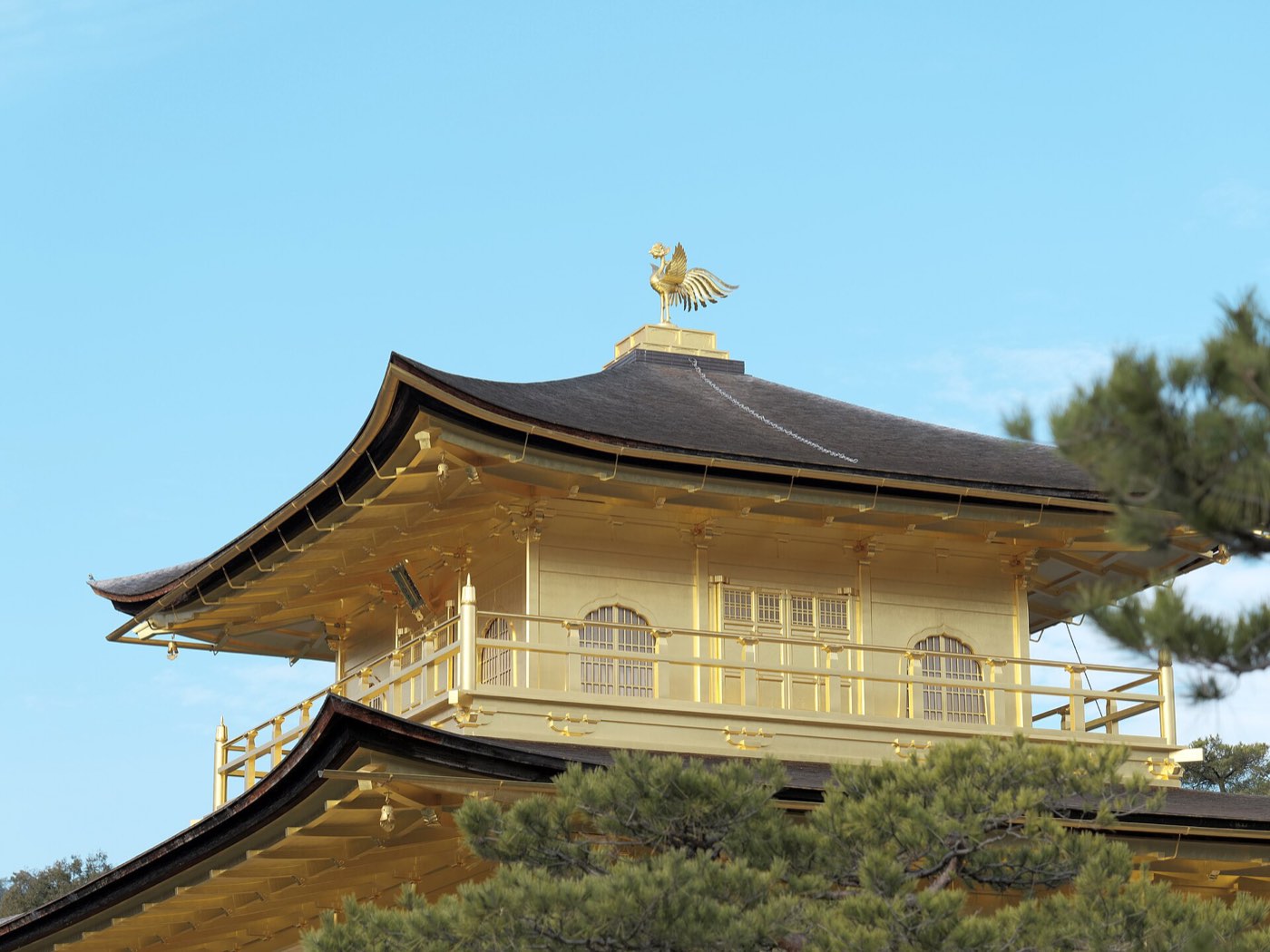
Kinkaku-ji vs
Ginkaku-ji
Same price, same city, same shogunal family, completely different visits. Kinkaku-ji gives you the most photographed building in Japan and 40 minutes on a one-way path you cannot walk back along. Ginkaku-ji gives you a moss garden, a raked sand cone, a hillside viewpoint and an hour you will actually remember, at half the crowd. First trip and one shot at it: Kinkaku-ji. Anyone with more than a single day: Ginkaku-ji. And the hard rule underneath all of it — never do both on the same day. They sit on opposite corners of Kyoto with no rail line between them.
The two-second version
Kinkaku-ji
Gold leaf across a mirror pond, and it really does look like the postcard. You cannot go inside, the path is one-way, and the visit is over in 40 minutes — so the whole game is being at the gate for the 9:00 opening. Worst-connected big sight in the city: no train, only buses you will not enjoy. Full verdict →
Tours that include it ↗Ginkaku-ji
No gold, no crowd, and a far better hour: a raked sand sea with the Kogetsudai cone in it, one of Japan's best moss gardens, and a hillside climb to a real view over the city. Walk in along the Philosopher's Path from Nanzen-ji and the approach is as good as the temple. Full verdict →
E-bike the northeast ↗Kinkaku-ji vs Ginkaku-ji, line by line
Same ticket price, same 15th-century Ashikaga family, and almost nothing else in common.
| What you care about | Kinkaku-ji | Ginkaku-ji | Winner |
|---|---|---|---|
| Entry | ¥500 cash at the gate | ¥500 cash at the gate | Tie |
| Time needed | 30–45 minutes, and no way to stretch it | 45–60 minutes, easily 90 with the path | Ginkaku-ji |
| Can you go inside? | No. Never, on any ticket | No, but the garden loop and hill path are the point | Ginkaku-ji |
| Crowd level at 11:00 | Avoid — a queue along a single pond railing | Busy but moving; the loop absorbs people | Ginkaku-ji |
| Garden quality | A pretty pond, then a short walk past a teahouse | Moss garden, sand garden and a hillside viewpoint | Ginkaku-ji |
| Transit from downtown | No train. Bus 101/205, or a ¥2,000–2,500 taxi | No train either, but you can walk in from Keage on the Philosopher's Path | Ginkaku-ji |
| Best hour | 8:45 at the gate for the 9:00 open, or 16:00 for light | 8:30 opening, or 16:00 — even midday is survivable | Kinkaku-ji |
| The photograph | The most photographed building in Japan, and it delivers | Photographs poorly. It is a place you stand in, not one you shoot | Kinkaku-ji |
| Verdict | Go once, go at opening, leave after 40 minutes | Go for an hour and walk the canal path afterwards | Ginkaku-ji |
Both are Rinzai Zen temples of the Shokoku-ji school, built by a grandfather and his grandson. Kinkaku-ji was rebuilt in 1955 after an arson; Ginkaku-ji has stood since 1482 and was never clad in the silver its name promises.
Which one, by who you are
If you only have room for one pavilion, this is the call, with no hedging.
| You are | Winner | Why |
|---|---|---|
| First-timers | Kinkaku-ji | It is the image you had of Japan before you booked, and not seeing it will nag. Go at 9:00 and be out by 9:40. |
| Photographers | Kinkaku-ji | There is one great shot in Kyoto's northwest and this is it. Be at the gate at 8:45 — by 10:00 the railing is three deep. |
| Couples | Ginkaku-ji | An hour in a moss garden and then two kilometres of canal path beats 40 minutes on a conveyor belt. Add Honen-in, which is free and empty. |
| Families | Kinkaku-ji | Short, flat, paved and over before anyone complains. Ginkaku-ji's hill path and quiet gardens ask more patience than most children have. |
| Second-timers | Ginkaku-ji | You already have the gold photograph. This is the one you will want to spend a morning in, and it connects to four more temples. |
| Only half a day | Ginkaku-ji | Better use of limited time and better connected — you can walk in from Keage on the Tozai subway. Kinkaku-ji costs you a bus ride each way with no train alternative. |
One caveat on the first-timer answer: if your half day is a rainy one, skip both and go to Sanjusangendo, which is ¥600, indoors and better than either.
Never do both on the same day
This is the most common routing mistake in Kyoto and it costs people two hours out of a three-day trip.
Kinkaku-ji is in the far northwest. Ginkaku-ji is in the far northeast. There is no rail line between them — no subway, no JR, no private line. Joining them means the city bus across the top of Kyoto, which takes 45 minutes to an hour in traffic, or a taxi at roughly ¥3,000.
Worse, you would be doing it in the middle of the day, which means arriving at the second pavilion at exactly the hour it is most crowded. You pay an hour of transit for the privilege of a worse visit.
The fix is simple. Put Kinkaku-ji on a northwest day with Ryoan-ji, Ninna-ji or Daitoku-ji, and reach it by Randen tram from Arashiyama. Put Ginkaku-ji on a northeast day with the Philosopher's Path, Honen-in, Eikan-do and Nanzen-ji, and reach it on the Tozai subway to Keage. Each is a clean half-day, and neither involves a bus across the city.
That is exactly how the 3-day itinerary clusters them, and why it puts them on different days.
Which pavilion fits which traveller
Kinkaku-ji, practically
Ginkaku-ji, practically
Getting to both without a bus
Neither temple needs a ticket in advance — ¥500 in cash at the gate, every day, and neither has ever sold out. The only problem worth paying to solve is that both sit off Kyoto's rail network. Temple gates take cash at the door and never sell out — a tour is worth paying for because of the guiding and the hour, not to skip a queue that does not exist.
Kinkaku-ji vs Ginkaku-ji FAQ
Which is better, Kinkaku-ji or Ginkaku-ji?
Kinkaku-ji is the better photograph and Ginkaku-ji is the better hour. If this is your first trip and you will see exactly one, take Kinkaku-ji at the 9:00 opening. If you have more than a single day in Kyoto, or you have already seen the gold one, Ginkaku-ji gives you a moss garden, a hillside view and half the crowd for the same ¥500.
Can I visit Kinkaku-ji and Ginkaku-ji in one day?
You can, and you should not. They are on opposite corners of Kyoto with no rail line between them — you would spend 45 to 60 minutes on a packed city bus in the middle of the day, arriving at the second one at its most crowded hour. Split them across two days in two different districts.
Is Ginkaku-ji actually silver?
No. Construction started in 1482 and the silver cladding was never applied, most likely because the Onin War drained the funds. The building is dark weathered timber. People who arrive expecting a silver counterpart to the golden pavilion leave disappointed; people who come for the sand garden and the moss stay an hour.
How much do Kinkaku-ji and Ginkaku-ji cost?
¥500 each, cash at the gate, no advance booking and no possibility of selling out. Together that is ¥1,000 — less than a single teamLab ticket. The expensive part is transport, since neither is on a train line.
Which one is better in autumn?
Ginkaku-ji, comfortably. Its hillside path and moss garden sit under maples, and the Philosopher's Path outside is one of the best autumn walks in the city. Kinkaku-ji's setting is mostly pine and pond, so it changes far less. Peak colour runs roughly 20 November to 5 December — see the autumn guide.
Which one is better with kids?
Kinkaku-ji. It is flat, fully paved, works with a pushchair, and the whole visit is 40 minutes, which is about the attention budget a temple gets from most children. Ginkaku-ji involves a hill path and rewards standing still, which is a harder sell.
If I can only do one temple in Kyoto, should it be either of these?
Probably not. Fushimi Inari is free, open 24 hours and the sight nobody regrets, and Kiyomizu-dera opens at 6:00, which no other headline sight does. The pavilions are excellent second and third choices, not first ones.