Is Ginkaku-ji
worth it?
Ginkaku-ji is the connoisseur's pick and it is not close. Same ¥500 as Kinkaku-ji, no gold, and a far better hour: a raked sea of silver sand with the Kogetsudai cone rising out of it, a moss garden that is genuinely one of the best in Japan, and a hillside path climbing to a real view over the city. It is never silver — it was never finished — and that disappoints exactly the people who came for a photograph. Everyone else stays 60 minutes instead of 30. Pair it with the Philosopher's Path and you have the best walking half-day in Kyoto.
What hour to go
Ginkaku-ji runs perhaps half the volume of Kinkaku-ji, and unlike its golden rival it has a garden loop and a hillside path that absorb people. Even a bad hour here is a survivable hour.
Opens 8:30. The first twenty minutes are close to empty and the moss is still wet from the morning — the best it looks all day.
What to expect at Ginkaku-ji
A 45 to 60-minute loop that starts in a sand garden, moves through moss and maples, climbs a hillside, and ends looking down over the roof of the pavilion with Kyoto spread out behind it. There is more to do here than at Kinkaku-ji, and it costs the same ¥500.
First, the disappointment nobody warns you about: Ginkaku-ji is not silver. The shogun Ashikaga Yoshimasa started it in 1482 as an answer to his grandfather's golden pavilion, ran out of money and political capital, and it was never clad. What you get is dark weathered timber over a pond, which is beautiful in a way that photographs badly and rewards standing still.
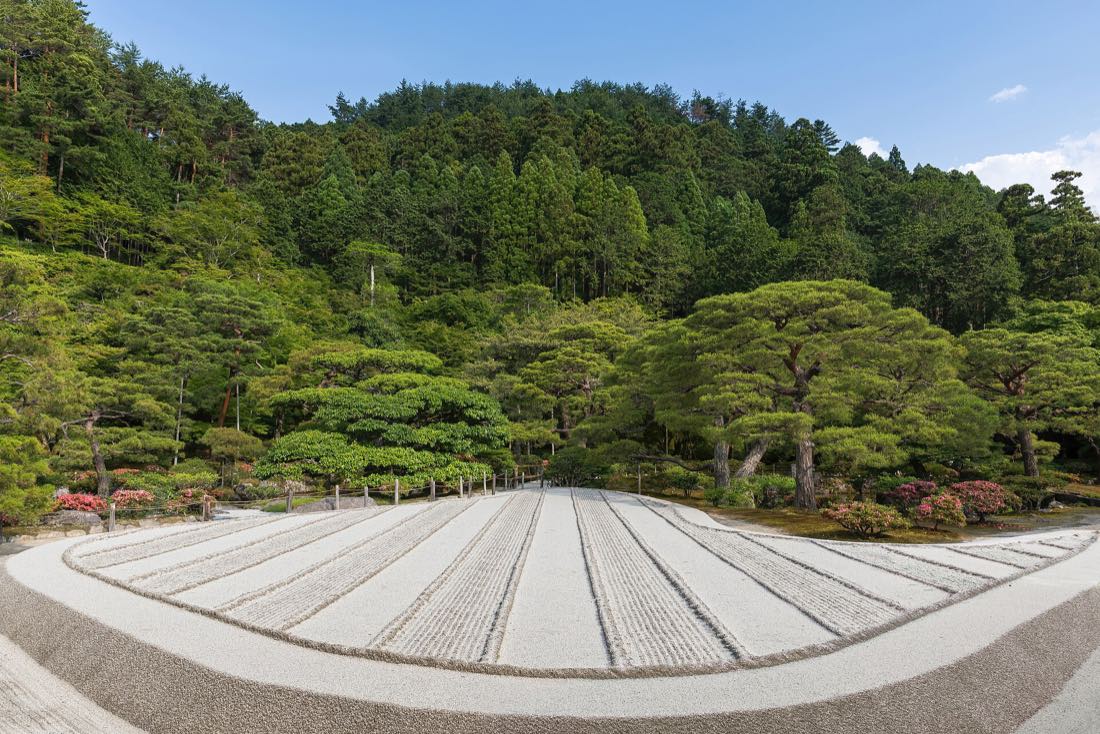
The Ginshadan — a raked plain of white sand meant to evoke the sea under moonlight — and the Kogetsudai, a two-metre truncated cone of sand beside it, are the images you will actually remember. They are re-raked constantly, and nobody is entirely sure what the cone represents, which is part of the appeal.
The moss garden around the pond is why garden people rate this temple above almost anything else in the city. Dozens of species, all maintained rather than tolerated, at their best in June during the rainy season and after any rain at all.
Then the path climbs. Five minutes of steps takes you above the temple to a viewpoint over the pavilion's roof and out across northeastern Kyoto. Kinkaku-ji has nothing equivalent — there, you look at a building; here, you look at a city.
One-way, like Kinkaku-ji, but a genuine loop rather than a corridor, and slow enough that 60 minutes feels natural rather than padded.
The best walking half-day in Kyoto
Ginkaku-ji sits at the northern end of a two-kilometre canal path that connects four more temples, three of them barely visited. This is the reason to come to this end of the city.
The Philosopher's Path runs south from Ginkaku-ji along a cherry-lined canal for about two kilometres — 30 minutes at a walk, an hour if you stop. It is free, it is shaded, and it peaks in early April when the cherries drop into the water and in mid-November when the maples turn. In February it is empty and just as pretty.
Honen-in is 200 metres off the path and free. A thatched gate, two raked sand mounds you walk between, moss, and almost never anyone else. It is the quiet counter-programming to everything else on this list.
Eikan-do is ¥600 most of the year and around ¥1,000 in the autumn viewing season, and it is one of the two or three best maple temples in Japan. In late November it is worth the surcharge and the crowd; in June it is a beautiful hillside complex with nobody in it.
Nanzen-ji anchors the southern end. The grounds are free, the Sanmon gate costs ¥600 to climb, and the brick Suirokaku aqueduct running through the compound is the most photographed non-temple structure in Kyoto. From there the Tozai subway at Keage takes you back downtown in ten minutes.
Walk it north to south and it is downhill the whole way. See the Northern Higashiyama guide for the full route.
Is Ginkaku-ji for you?
The practical bit
Getting around the northeast
Ginkaku-ji takes ¥500 in cash at the gate and has never sold out. The thing worth solving here is transport: this corner of Kyoto has no subway station, and the buses that serve it are the ones locals avoid. Temple gates take cash at the door and never sell out — a tour is worth paying for because of the guiding and the hour, not to skip a queue that does not exist.
Ginkaku-ji FAQ
Is Ginkaku-ji actually silver?
No, and it never has been. Construction began in 1482 and the silver cladding was never applied, most likely because the Onin War drained the money. The name came later. If you go expecting a silver building you will be disappointed; go for the sand garden, the moss and the hillside view and you will stay an hour.
Is Ginkaku-ji better than Kinkaku-ji?
For most people who have already done one of them, yes. Ginkaku-ji costs the same ¥500 and gives you a garden loop, a moss garden, a hillside viewpoint and roughly half the crowd. Kinkaku-ji gives you a better photograph and 40 minutes. The full comparison calls it by traveller type.
How long does Ginkaku-ji take?
Forty-five to sixty minutes for the temple loop including the climb to the viewpoint. Add 30 minutes if you walk the Philosopher's Path to Honen-in and back, or budget a half day and walk the whole two kilometres south to Nanzen-ji.
How do I get to Ginkaku-ji without taking a bus?
Take the Tozai subway to Keage, walk into Nanzen-ji, then follow the Philosopher's Path north for about 40 minutes. It is free and it is one of the best walks in the city. The alternative is bus 5, 17 or 100 to Ginkakuji-michi, which works but is usually full.
Can I do Kinkaku-ji and Ginkaku-ji on the same day?
You can, and you should not. They sit on opposite corners of Kyoto with no rail line between them — joining them means an hour or more on packed buses in the middle of your day. Put them on different days in different districts, which is how the 3-day itinerary handles it.
What is the best thing near Ginkaku-ji?
Honen-in, 200 metres off the Philosopher's Path, free, with a thatched gate and two raked sand mounds — and usually nobody in it. Eikan-do (¥600, around ¥1,000 in autumn) is the maple temple that justifies the whole walk in late November, and Nanzen-ji's brick aqueduct at the far end is free to walk through.
When is the Philosopher's Path at its best?
Early April for the cherry canopy over the canal and mid-to-late November for the maples — both crowded. The underrated answer is February, when it is empty, or immediately after rain in June when the moss at Ginkaku-ji is at its most saturated.