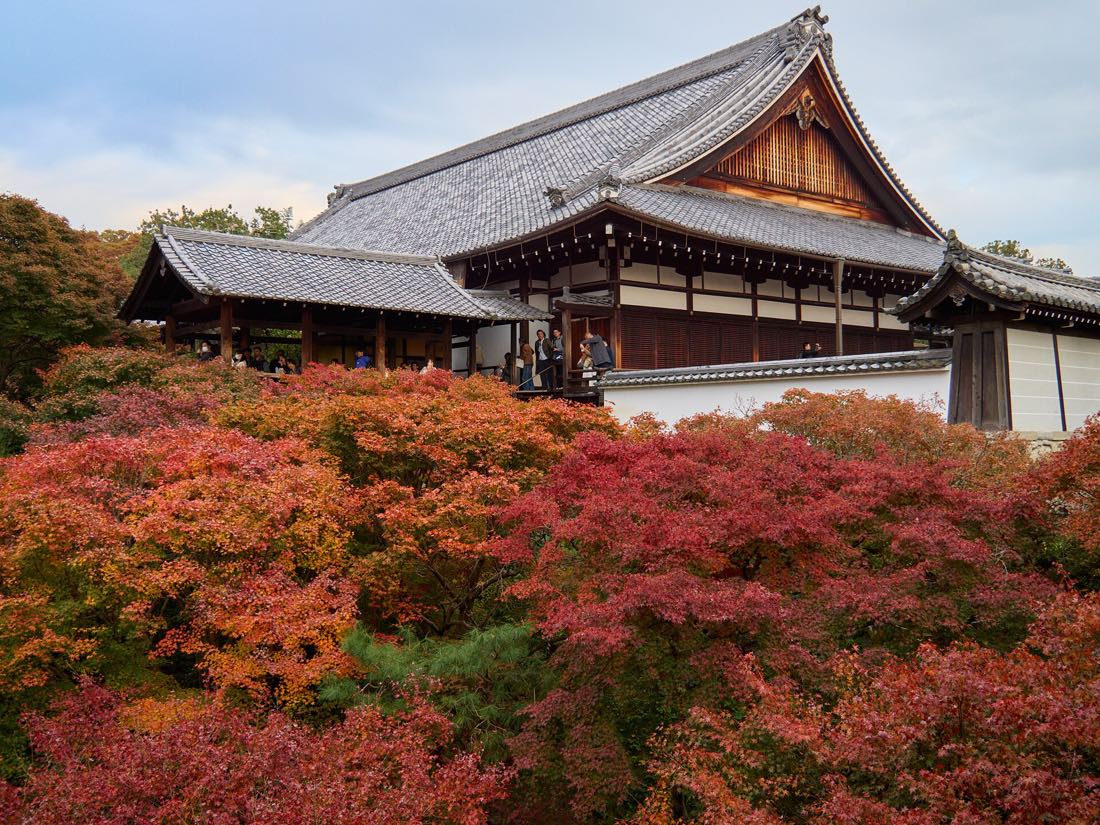
Autumn leaves
in Kyoto
Three weeks a year Kyoto turns red and the entire country arrives to look at it. The colour is better than the photographs suggest and the crowds are worse. Here is when, where, and the ten days everyone else misses.
Colour starts around 10–15 November, peaks 20 November to 5 December, and drifts later with every warm year — 2025 ran into mid-December. The kings are Tofuku-ji, Eikan-do and the Arashiyama valley, and all three are painful after 09:30. The two moves that fix it: go to Takao, where colour runs one to two weeks earlier and there are a fraction of the people, and target 1–10 December, when the colour is still holding and the crowds have started to leave. Weekdays run 30–40% quieter than weekends.
When the autumn colour actually peaks in Kyoto
Colour begins around 10–15 November in the city, peaks between 20 November and 5 December, and holds usefully for another week after that. The mountains north and west turn one to two weeks earlier than the centre.
The trend is later, not earlier. Autumn colour is triggered by cold nights, and Japan's warming autumns have pushed Kyoto's peak steadily back — 2025 ran into mid-December, which would have been unthinkable twenty years ago. If you are choosing between late November and early December for a 2026 trip, early December is now the safer bet on colour as well as on crowds.
Altitude does the work. Takao, Kurama and Ohara are 200–400 metres higher than central Kyoto and turn one to two weeks ahead of it. That makes early November a real trip rather than a wasted one, as long as you leave the city for it.
The smartest window is 1–10 December. The maples at Eikan-do, Tofuku-ji and Arashiyama are still holding, the illumination programmes are usually still running, hotel rates have come off the late-November peak, and the domestic tour groups have gone home. Nobody advertises this window because it feels like arriving late. It is not.
The worst window is the last weekend of November. It is simultaneously the peak of the colour, the peak of domestic travel and the tightest hotel availability of the entire Kyoto year — tighter than sakura, because autumn draws far more Japanese travellers. If your dates are fixed to that weekend, book nine months out and go to Takao on the Saturday.
The autumn kings, with the honest crowd warning
Autumn prices are not the usual prices — several temples add a surcharge for the koyo weeks, and the numbers below reflect that.
| Where | Cost | Peak colour | The honest warning | Verdict |
|---|---|---|---|---|
| Tofuku-ji | ¥600, ~¥1,000 in autumn | Late Nov | The Tsutenkyo bridge over its maple valley is the single most crowded koyo site in Kyoto. Photography is banned on the bridge itself in peak season to keep people moving. Be there for the 08:30 opening on a weekday or genuinely do not bother | WORTH IT |
| Eikan-do Zenrin-ji | ¥600, ~¥1,000 autumn, ~¥600–700 night | Late Nov–early Dec | Kyoto's number one maple temple, with around 3,000 trees and a hillside pagoda. Also one of its busiest — the night opening is the better ticket and a separate entry from the daytime one | WORTH IT |
| Arashiyama valley | Free · Tenryu-ji ¥500 | Late Nov | The whole valley turns, and the Sagano torokko railway at ¥880 one-way sells out through November. Before 08:30 or after 16:00 only. The district guide | DEPENDS |
| Takao | Temples ¥500–600 · JR bus ~50 min | Early–mid Nov | The early-November answer, and the one on this table with room to breathe. Colour arrives one to two weeks before the city and the crowd is a fraction of it. Jingo-ji is a steep 400-step climb from the river | WORTH IT |
| Rurikoin | ¥2,000, reservation required | Late Nov | The lacquered table reflecting the maples is the photo you have seen. It opens only for the autumn and spring windows, reservations are required, and it is the most expensive maple ticket in the city | DEPENDS |
| Genko-an | ¥600–1,000 autumn | Late Nov | Two windows — one round, one square, the Window of Enlightenment and the Window of Delusion — framing a maple garden. Small temple, northwest of the centre, and a much calmer visit than its fame suggests | WORTH IT |
| Daigo-ji | ¥1,000–1,500 | Late Nov–early Dec | The Bentendo hall reflected in its pond is the calendar shot of Kyoto in autumn. Southeast of the city and far enough out that day-trippers thin | WORTH IT |
| Kibune and Kurama | ¥470 train · ¥500 temple | Mid Nov | Cedar and maple on the Eizan line, which runs a lit "maple tunnel" section at night. A hike rather than a temple visit — see day 5 of the 5-day itinerary | WORTH IT |
| Ohara, Sanzen-in | ¥700 · bus 17, 60 min, ¥600 | Mid–late Nov | Moss, jizo statues and maples in a mountain village. Dead by 17:00, so it is a morning trip only | WORTH IT |
Two temples that are free and turn beautifully: Nanzen-ji's grounds, including the aqueduct, and Honen-in off the Philosopher's Path. Neither charges a yen and neither appears on the coach itineraries.
Night openings — 2025 dates, to be re-checked each October
Several temples open after dark and light the maples for the koyo weeks. The dates below are the 2025 windows and are printed here only as a template — every temple republishes its dates each October, because the schedule follows the colour. Verify before you book anything around them.
Eikan-do — 15 November to 10 December 2025, around ¥700 for the night entry, separate from the daytime ticket. The best of them: 3,000 maples lit around a pond, and a hillside you climb in the dark.
Kiyomizu-dera — 22 November to 7 December 2025, ¥500. A blue beam is fired from the temple across the city and the veranda is floodlit. Extremely popular, and the queue moves.
Kodai-ji — 24 October to 14 December 2025, which is the longest window of any of them. Known for a projection-mapped garden that divides opinion; the bamboo grove behind lit at night does not.
To-ji — 1 November to 14 December 2025, around ¥1,000. The five-storey pagoda reflected in the pond is the frame, and it is a five-minute walk from Kyoto Station, which makes it the easiest night opening to slot into a day.
Kitano Tenmangu's momiji-en — around ¥1,200 including tea and a sweet, in a maple garden along a stream behind the shrine. The tea is not a token gesture and the garden is genuinely quiet.
Note again: the Arashiyama and Higashiyama Hanatoro festivals no longer exist — the last ones ran in December 2021 and spring 2022. Any blog listing them is copying an old page.
The autumn window, month by month
Scores here are for autumn colour specifically, not for Kyoto in general. The crowd bars are relative to Kyoto's own annual peak, which is the last weekend of November.
The one-line version: early November go to Takao, 20 November–5 December is the peak everywhere, and 1–10 December is the smartest single window — the colour tail plus thinning crowds plus softer hotel rates. Weekdays run 30–40% quieter than weekends throughout.
Autumn without queueing for the bridge
The crowd maths in November is simple: weekdays are 30–40% quieter than weekends, mornings are quieter than afternoons, and anywhere 30 minutes outside the city is quieter than everything.
Take the 08:30 openings seriously. Tofuku-ji at 08:30 on a Tuesday is a maple valley; Tofuku-ji at 11:00 on a Sunday is a managed queue with photography banned on the bridge. That is the same temple and two entirely different mornings.
Put Takao in the plan if you are here before 15 November. A JR bus from Kyoto Station takes about 50 minutes to the Takao valley, where Jingo-ji, Saimyo-ji and Kozan-ji sit above a river. Colour arrives one to two weeks ahead of the city. Jingo-ji is a 400-step climb, so wear real shoes.
Use the illuminations to move your day. A night entry at Eikan-do or Kiyomizu turns a crowded afternoon into a free one — sleep, eat early, and go to the temple at 18:00. It is the same trick as the 6:00 opening, at the other end of the day. See Kyoto at night.
Book the Sagano torokko early or skip it. The scenic railway is ¥880 one-way, car 5 is the open-air one, and it sells out through the November window. It also closes most Wednesdays and all of January and February. Pair it with the Hozugawa river boat at ¥6,000 for the two-hour run down to Arashiyama if you want the full valley day.
Do not schedule a bus anywhere in late November. Kyoto's roads in koyo season are the single worst transport situation of the year, and the ¥230 city bus that takes 25 minutes in March takes 70 in November. Trains and walking, always — the transport page.
The autumn booking calendar
Late November is the tightest hotel week in the Kyoto year — tighter than cherry blossom, because domestic travellers dominate it.
Autumn tours worth the money
In koyo season what you are buying is routing — a guide who knows to be at Tofuku-ji at 08:30 and at Eikan-do after dark, and transport that is not a Kyoto city bus in November.
Kyoto autumn leaves FAQ
When is the best time to see autumn leaves in Kyoto?
20 November to 5 December for the city, with colour starting around 10–15 November. The peak has drifted later with warmer autumns — 2025 ran into mid-December. If you want one date to aim at for 2026, make it the first week of December.
Where is the best autumn foliage in Kyoto?
Eikan-do for sheer density, with around 3,000 maples; Tofuku-ji for the Tsutenkyo bridge over its valley; and Daigo-ji's Bentendo pond for the photograph. All three are ¥600–1,500 and all three are unbearable after 09:30 in peak week.
How do I avoid the crowds for autumn leaves in Kyoto?
Three moves. Go to Takao in early November, when colour arrives one to two weeks before the city and the crowd is a fraction. Go on a weekday, which runs 30–40% quieter. And target 1–10 December, when the colour is still holding and the tour groups have gone.
Is Tofuku-ji worth it in November?
Yes, at 08:30 on a weekday. It is the most spectacular maple valley in the city and also the most crowded koyo site in Kyoto, with photography restricted on the Tsutenkyo bridge in peak season to keep the queue moving. Entry rises from ¥600 to about ¥1,000 for the autumn window.
Are the Kyoto autumn illuminations worth it?
Yes, and they solve a scheduling problem — going at 18:00 frees your afternoon. Expect ¥500–1,200: Eikan-do around ¥700, Kiyomizu ¥500, To-ji about ¥1,000, Kitano's momiji-en around ¥1,200 with tea. Re-check the dates each October, because they follow the colour and change every year.
Is autumn more crowded than cherry blossom in Kyoto?
In hotels, yes — the last weekend of November is the tightest availability of the Kyoto year, because domestic travellers dominate autumn while sakura pulls more international ones. The autumn window is also three weeks long against sakura's one, which spreads the load at the sights.
Do I need a JR Pass or a bus pass in autumn?
Neither, and buses in particular are a trap in November when Kyoto's roads seize up. Use trains, the subway and the Eizan and Randen lines. If you are doing Kurama or Ohara, the ¥4,380 two-day Kansai Thru Pass covers both — see the transport page.